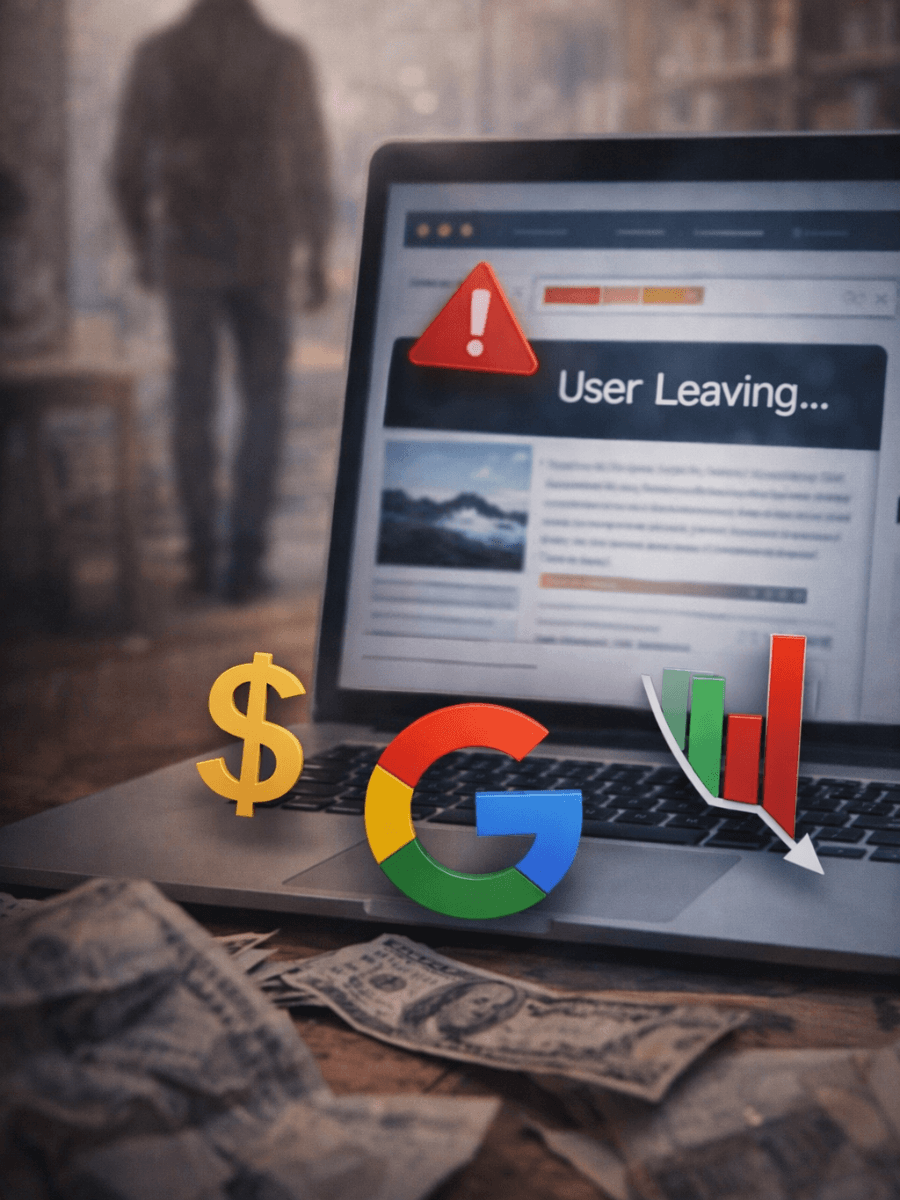
7 Signs Your Website Is Costing You Customers
Seven warning signs your website is quietly driving customers to your competitors — and what each one is costing you.
 Is My Website Holding Me Back?No. 04
7 Signs Your Website Is Costing You Customers
May 2026
The Silent Revenue Leak
Your website costing you customers is not a hypothetical — it is happening right now, and the worst part is you probably have no idea.
Nobody sends you an email that says "I was going to hire you, but your site loaded too slowly, so I went with your competitor instead." There is no notification when a potential customer opens your homepage on their phone, squints at tiny text, and hits the back button. The revenue you lose to a bad website is invisible — a silent leak that compounds every single day.
Here is what makes this problem particularly dangerous: most business owners think their website is fine. They built it a few years ago, it looked good at the time, and they have been too busy running the business to think about it since. Meanwhile, their customers' expectations have shifted dramatically. A site that was acceptable in 2022 can feel painfully outdated in 2026. And outdated does not just mean ugly — it means slow, confusing, and invisible to the people searching for exactly what you sell.
This article walks through seven concrete warning signs — the signs you need a new website that most owners overlook. Some are obvious once you know what to look for. Others are subtle enough that they can bleed revenue for years before anyone notices. If even two or three of these apply to your site, the cost of inaction is almost certainly higher than the cost of fixing it.
Sign 1 — Your Site Takes More Than 3 Seconds to Load
Speed is not a technical vanity metric. It is a revenue multiplier.
Research from Portent, analysing over 100 million page views across 20 websites, found that a site loading in one second converts at three times the rate of a site loading in five seconds. For e-commerce specifically, every additional second of load time drops conversion rates by an average of 0.3%. Run that math against your monthly traffic and average order value — the number is almost always larger than business owners expect.
Google's own data reinforces the pattern: as page load time increases from one second to three seconds, the probability of a visitor bouncing increases by 32%. Push that to five seconds and the bounce probability jumps to 90%. Nine out of ten people leave before they see a single word of your content.
The frustrating part is that most slow websites are not slow because of some deep architectural flaw. They are slow because of oversized images, bloated plugins, cheap shared hosting, or template platforms stacking unnecessary JavaScript on every page. These are fixable problems — but only if you know they exist.
Pull up your site on your phone right now, on cellular data, not on your office Wi-Fi. Count the seconds. If you are waiting more than three, your customers are not waiting at all. They are leaving. We dig much deeper into the mechanics of speed and conversion in our upcoming spoke, What Happens When a Customer Visits Your Site and Leaves in 3 Seconds.
Sign 2 — It Looks Wrong on a Phone
Mobile devices account for roughly 65% of all global website traffic. In retail, that number is even higher. If your site was designed primarily for desktop and simply squeezed down to fit a phone screen, you are delivering a broken experience to the majority of your visitors.
"Broken" does not always mean obviously broken. Sometimes it means a navigation menu that requires precise tapping to open. Sometimes it means text that is technically readable but uncomfortably small. Sometimes it means a contact form where the submit button sits half off-screen. Each of these friction points is a decision point for your visitor — and the decision is almost always to leave.
The data backs this up conclusively. According to a GoodFirms survey of over 200 web designers, 73.1% cited non-responsive design as the top reason visitors leave a website. A separate study found that 57% of users will not recommend a business with a poorly designed mobile site. That means a bad mobile experience does not just cost you the visitor in front of you — it costs you every referral that visitor would have made.
85% of adults expect a company's mobile site to be as good or better than the desktop version. Not "adequate." Not "functional enough." As good or better. That is the bar, and most small business sites do not clear it.
We explore the full mobile experience gap — what business owners see versus what their customers experience — in Why Your Website Looks Great to You But Terrible on Your Customer's Phone.
Sign 3 — Nobody Can Find You on Google
You could have the best product in your market, the most competitive pricing, and a perfectly designed website — and none of it matters if nobody can find you.
Search is still where most buying journeys begin. When someone searches "plumber near me" or "custom furniture shop" or "best cannabis dispensary in Denver," the businesses that appear on that first page of results get the customers. Everyone else gets nothing. Not some customers — nothing. Research consistently shows that fewer than 1% of searchers click through to the second page of Google results.
If your website does not show up for the terms your customers are searching, you are invisible. And visibility on Google is not random. It is the result of specific technical and content decisions: whether your site loads quickly, whether it works on mobile, whether your pages have clear titles and descriptions, whether your content actually addresses what people are searching for, and whether other reputable sites link to yours.
Many small business websites fail on the basics. They have no meta descriptions, so Google generates its own (usually poorly). They have no structured headings, so search engines cannot figure out what the page is about. They have duplicate title tags across every page, so Google has no reason to rank page two over page one. These are not advanced SEO tactics — they are foundational hygiene that template platforms and DIY builders often skip entirely. And if you have ever searched "is my website hurting my business" — the fact that you are invisible on Google is your answer.
We break down the full picture of search visibility — what actually moves the needle and what is just noise — in our upcoming piece, The Real Reason Your Website Doesn't Show Up on Google. For a broader primer, our future cluster on SEO in Plain English will cover everything business owners need to know without the jargon.
Signs 4–7 — The Ones You Are Probably Ignoring
The first three signs are the headline problems — speed, mobile, and search visibility. They affect the most people and cost the most revenue. But there are four more that quietly compound the damage, and most business owners do not think about them at all.
Sign 4: No Clear Call to Action
A staggering 70% of small business websites lack a clear call to action on their homepage. Seventy percent. That means seven out of ten small businesses are essentially saying "here is some information about us" and then hoping the visitor figures out what to do next.
Visitors do not figure it out. They leave.
Every page on your site should answer one question for the visitor: what do you want me to do right now? Call you. Fill out a form. Book an appointment. Request a quote. Buy the product. If the answer is not immediately obvious — within five seconds of landing on the page — you have a call-to-action problem.
Sign 5: Outdated Design
75% of consumers judge a company's credibility based on its website design. That is not an opinion — it is a research finding from multiple studies spanning over a decade. First impressions form in roughly 50 milliseconds, and 94% of those first impressions are design-related.
An outdated website does not just look bad. It signals that the business behind it might be outdated too — inattentive, behind the curve, maybe not even still operating. Fair or not, that is how visitors interpret a site that looks like it was built five years ago. The average lifespan of a website design is 1.5 to 2.5 years before it starts feeling stale. If yours is older than that, your visitors notice even if you do not.
Sign 6: Buried Contact Information
88% of consumers who search for a local business on a mobile device call or visit that business within 24 hours. These are high-intent visitors — they already want what you sell and they are ready to act. If your phone number is buried in a footer, your address requires three clicks to find, or your contact form is hidden behind a generic "About Us" page, you are putting friction between a ready buyer and a sale.
Contact information should be visible on every page. Phone number in the header. Address in the footer. Contact form accessible in one click from anywhere on the site. This is not complicated, but you would be surprised how many sites make it harder than it needs to be.
Sign 7: No Clear Message About What You Do
Users spend an average of 5.59 seconds looking at a website's written content. Five and a half seconds to understand what your business does, who it serves, and why they should care.
If your homepage headline is vague — "Innovative Solutions for Modern Businesses" or "Taking Your Brand to the Next Level" — you have already wasted those five seconds. Visitors want specifics. "Commercial Plumbing for Restaurants and Hotels in Denver." "Handmade Leather Goods, Shipped in 3 Days." "Custom Websites That Load in Under Two Seconds." Say what you do, say who you do it for, and say it immediately.
38% of people will stop engaging with a website if the content or layout is unattractive. Another 39% will leave if images do not load or take too long. These are not picky users — they are normal people with a dozen other options one click away.
What Your Competitor Already Fixed
Here is the uncomfortable truth: while you wonder whether your website hurting my business is a real concern or just paranoia, somebody in your market has already addressed these problems.
They invested in a faster hosting setup. They rebuilt their site for mobile-first. They wrote clear, specific headlines. They put a call-to-action button above the fold on every page. They made sure their phone number was visible without scrolling. They got their Google Business Profile dialled in and their meta descriptions written properly.
And now they are getting the customers who used to be yours.
This is not a hypothetical. Businesses that fix basic website issues see measurable, immediate results. Swiss Gear saw an 84% increase in time-on-site and a 132% increase in year-over-year online revenue after a targeted conversion audit and website redesign. Those are not marginal improvements — they are transformational, and they started with identifying exactly the kinds of problems outlined in this article.
The gap between your site and a competitor who has invested does not stay the same over time. It widens. Every month your site remains slow, invisible, or confusing — your website costing you customers month after month — the competitor captures more market share, builds more reviews, earns more backlinks, and entrenches their position in search results. The longer you wait, the harder and more expensive the catch-up becomes.
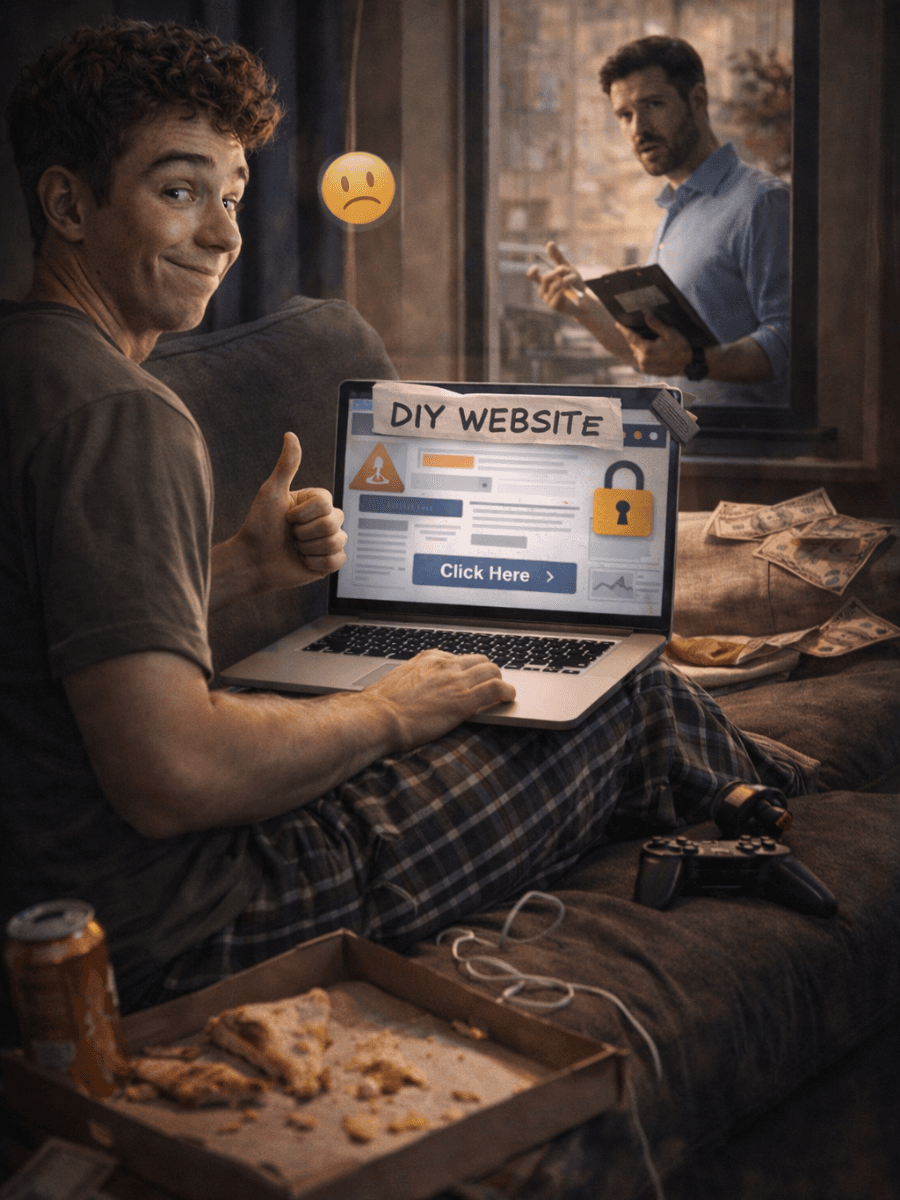
We examine this competitive dynamic in detail in Your Competitor's Website Is Outperforming Yours — Here's What They Did. And if you are wondering whether a DIY fix or a family favour is the answer, our piece on "My Nephew Built My Website" — When DIY Costs More Than Hiring a Pro breaks down the real cost of cutting corners.
The Self-Audit
Before you do anything else, run through this checklist. It takes ten minutes and costs nothing:
Speed test. Open Google PageSpeed Insights and enter your URL. If your mobile performance score is below 50, you have a speed problem.
Phone test. Open your site on your phone. Can you read everything without zooming? Can you tap every button without accidentally hitting the wrong one? Can you find your contact information in under five seconds?
Search test. Open an incognito browser window and search for your primary service plus your city. If you are not on the first page, your customers are finding someone else.
CTA test. Look at your homepage. Within three seconds, can you identify exactly what you want the visitor to do? If not, neither can they.
Freshness test. When was the last time your site's design was updated? If the answer is more than two years ago, it is likely a website costing you customers through outdated impressions alone.
Contact test. Can a visitor find your phone number, address, and a contact form without scrolling or clicking more than once?
Clarity test. Read your homepage headline out loud. Does it clearly state what you do and who you serve? If it could apply to any business in any industry, it is too vague.
If you failed three or more of these, your website is actively working against you — a clear case of website hurting my business in action. Every day it stays that way is revenue you will never recover. These are the signs you need a new website, and they do not improve on their own.
The Engine8 Approach
We build websites that are engineered to convert — fast, mobile-first, visible on search, and structured around clear calls to action from the first pixel. Every site we deliver is tested against the exact checklist above before it goes live, because the signs you need a new website are the same signs we design against from day one.
Not sure where you stand? Our free site evaluation runs a live scan of your site in under 60 seconds — performance, mobile readiness, and conversion drag scored and summarised, no sign-up required.
If your site is showing any of these warning signs — or if you are not sure and want a professional assessment — start a conversation. We will run a full audit, show you exactly where you are losing customers, and build a plan to fix it.
No pitch decks. No filler. Just engineering.
Your move
Want leads from content like this?
Get a custom web engine with built-in SEO, analytics, and conversion systems.
Explore related keywords
Your move
Turn this strategy into a production-ready growth engine.
We design, build, and ship custom systems that combine SEO, conversion architecture, and operations automation into one platform.