The Real Reason Your Website Doesn't Show Up on Google
If you search for your business on Google and can't find yourself, your customers can't either. Here are the real reasons — and the fixes.
 Is My Website Holding Me Back?No. 07
The Real Reason Your Website Doesn't Show Up on Google
Jun 2026
You Googled Yourself and Got Nothing
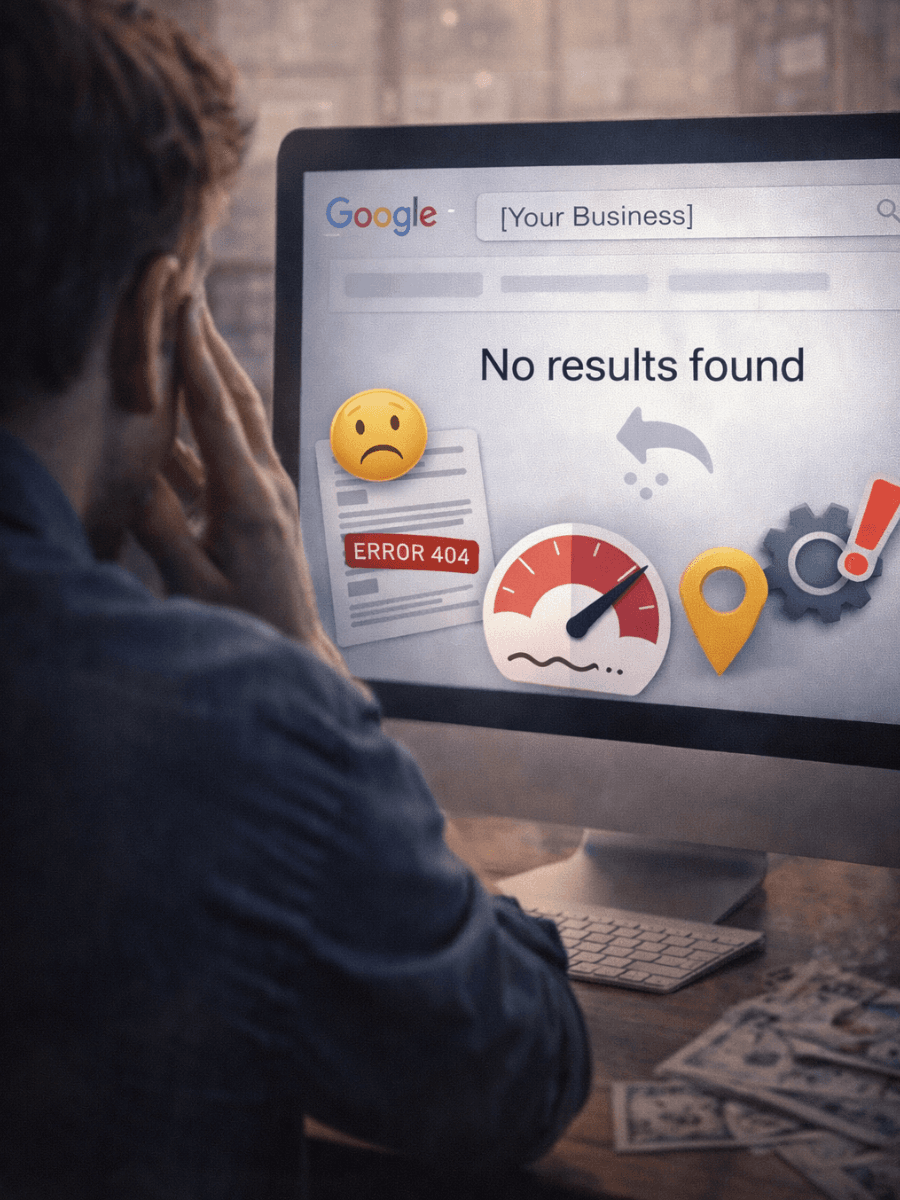
You typed your business name into Google. Then you typed what you sell. Then you typed your service plus your city. And every time — nothing. Page two, page three, buried under directories and competitors, or flat-out missing. Your website not showing up on Google is not a minor inconvenience. It is the digital equivalent of opening a shop, locking the front door, and turning off all the lights.
If you have been reading 7 Signs Your Website Is Costing You Customers, you already know that search invisibility is one of the most expensive warning signs a business can ignore. This article goes deeper into why it happens, what Google is actually looking for, and what you can do about it — starting today.
Here is the uncomfortable truth most web designers will not tell you: Google does not owe your website a spot in search results. It has to be earned. And the reasons why can't customers find my website are almost always fixable — once you know where to look.
Google Doesn't Automatically Know Your Site Exists
Most business owners assume that the moment a website goes live, Google sees it and starts showing it to people. That is not how it works. Not even close.
Think of it like this: Google is a librarian managing a library with billions of books. Your website is a new book that just got dropped on the doorstep with no label, no cover, and no catalogue entry. The librarian has to find it, read it, decide what it is about, and figure out where it belongs on the shelf. If you never tell the librarian the book exists, it sits in a pile in the back room — indefinitely.
Google discovers websites through three stages: crawling (its automated programmes, called crawlers, follow links across the internet to find new pages), indexing (it reads the page, figures out what the content is about, and stores it in a massive database), and serving (when someone searches, Google pulls the most relevant results from that database). If your site fails at any of these stages, you are invisible.
The most common reason a brand-new website does not appear on Google? Nobody told Google it existed. No sitemap was submitted. No links from other websites point to it. Google's crawlers had no way to find the front door. It is like printing business cards and leaving them in your desk drawer — technically they exist, but nobody will ever see them.
The 5 Most Common Reasons Businesses Are Invisible Online
When a business owner asks why can't customers find my website, the answer is almost always one (or more) of these five issues. None of them are mysterious. All of them are fixable.
1. Your site has no relevant content
Google matches search queries to pages that contain relevant information. If your entire website is a homepage with your logo, a stock photo, and a phone number — there is nothing for Google to match against. Someone searching "emergency plumber in Austin" will not find your site if those words do not appear anywhere on your pages.
Think of it like this: imagine walking into a hardware store where every shelf is empty except for a sign that says "We sell stuff." You would turn around and leave. Google does the same thing.
Every service you offer needs its own page with clear, specific text describing what you do, where you do it, and who you do it for. Google cannot read your mind — it can only read your website.
2. Your page titles and descriptions are missing or generic
Title tags and meta descriptions are the text Google shows in search results. If your homepage title is "Home" and your about page title is "About" — Google has no idea what your business does. These tags are your first impression in search results. A page titled "24/7 Emergency Plumbing in Austin, TX — Smith Plumbing" tells both Google and the searcher exactly what they will find. A page titled "Home" tells them nothing.
Backlinko's analysis of 4 million Google search results found that title tags between 40 and 60 characters have the highest click-through rates — 33.3% higher than titles outside that range. Your title is not decoration. It is a billboard on the busiest highway in the world.
3. Your site is too slow
Google has confirmed that page speed is a ranking factor. If your site takes four or five seconds to load, Google notices — and so does every visitor. We covered this in detail in What Happens When a Customer Visits Your Site and Leaves in 3 Seconds. Slow sites get visited less often by Google's crawlers, rank lower in results, and bleed visitors who will not wait. It is a triple penalty.
4. You have no Google Business Profile
If you serve local customers and you have not claimed your Google Business Profile, you are missing out on the single most powerful free tool for small business Google search visibility. We will dig into this in the next section — it deserves its own heading.
5. No other website links to yours
Links from other websites are how Google discovers new pages and how it judges credibility. If zero external sites link to yours, Google has fewer paths to find you and less reason to trust you. Think of it like this: if you open a new restaurant and nobody in town has ever mentioned it, recommended it, or even acknowledged it exists — how would anyone know to walk through the door? Links are digital word-of-mouth.
You do not need thousands of links. Even a handful from local directories, your Chamber of Commerce, industry associations, or partner businesses can make a meaningful difference. Quality matters far more than quantity.
Fun Facts
Google's index contains hundreds of billions of web pages and is over 100 million gigabytes in size — yet your site still has to earn its spot in that library.
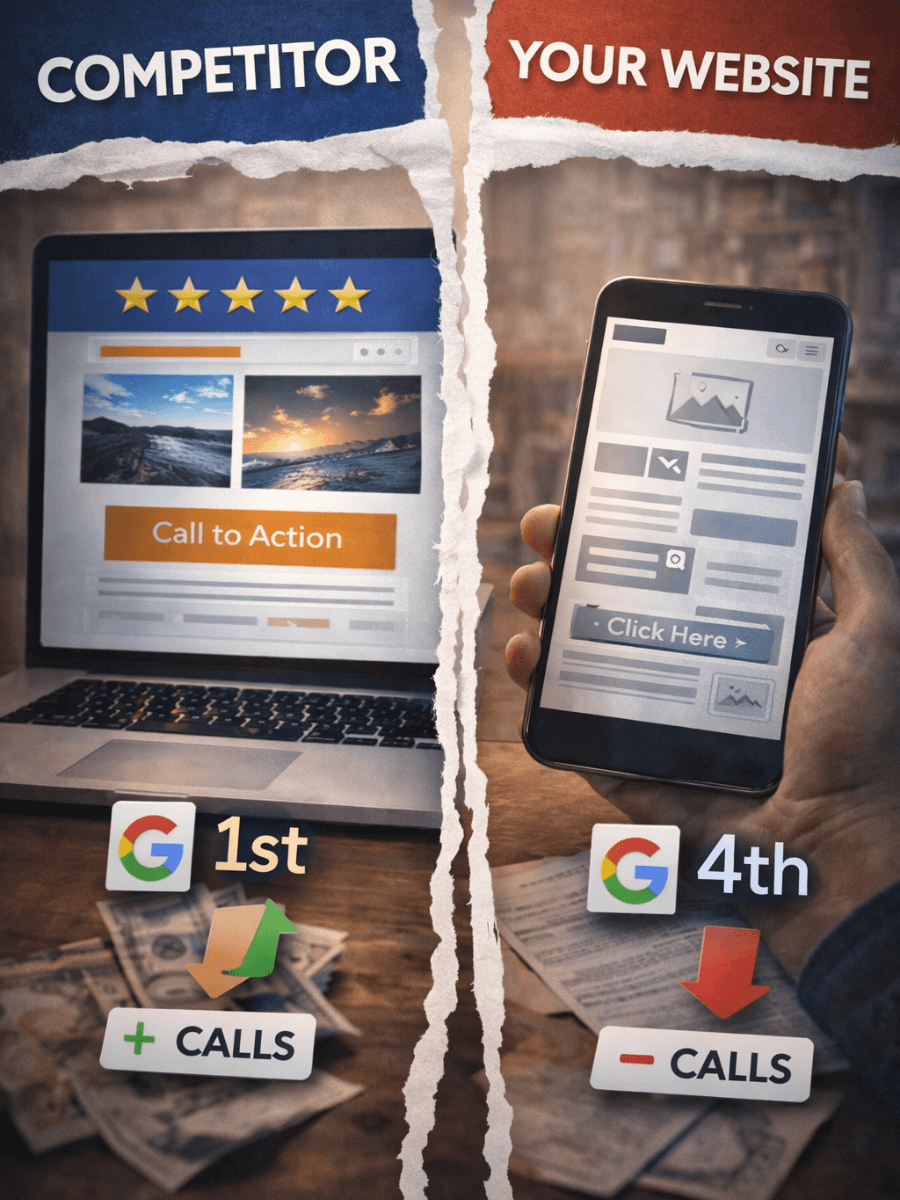
The #1 result in Google gets 27.6% of all clicks. The #10 result? Just 2.4%. Being on page one is not enough — position matters enormously.
46% of all Google searches have local intent, meaning nearly half the people searching right now are looking for a business near them.
Only 0.63% of Google searchers click on something from the second page. If you are not on page one, you are effectively invisible.
The Google Business Profile You're Probably Ignoring
If your business serves customers in a specific area — a city, a region, a neighbourhood — your Google Business Profile (GBP) is arguably more important than your website for local search visibility. It is what powers the map pack: those three business listings with a map that appear at the top of local search results. And 42% of people who search for local businesses click on results in that map pack.
Here is what is maddening: setting up a Google Business Profile is completely free. It takes about 20 minutes. And a staggering number of business owners either have not claimed theirs, or they claimed it three years ago and never filled it out properly.
A complete GBP includes your business name, address, phone number, website link, business hours, service categories, photos, and — crucially — reviews. BrightLocal research shows that 80% of US consumers search online for local businesses weekly, and 83% use Google to find local business reviews. If your profile is empty, or worse, if it has outdated hours or a wrong phone number, 62% of consumers say they would avoid using your business entirely.
Think of it like this: your Google Business Profile is your storefront window on the busiest street in town. Right now, you either have no window, or it is covered in dust with a "maybe we're open?" sign taped to the glass. Twenty minutes of work could change that.
For a deeper dive into how Google Business Profile can outperform paid advertising for local businesses, our upcoming piece on Google Business Profile: The Free Tool That Might Matter More Than Your Website covers the full strategy.
What You Can Check Right Now
You do not need to hire anyone to diagnose most of these problems. Here is your five-minute checklist:
Search your exact business name on Google. If your website does not appear in the top three results for your own name, something is fundamentally wrong — either your site is not indexed, or another listing is outranking you.
Search your service + your city. For example: "emergency plumber Austin" or "wedding photographer Portland." If you are nowhere on page one, your site is not optimised for the terms your customers actually use.
Check Google Search Console. This is a free tool from Google that tells you exactly which pages Google has crawled and indexed, and which ones it has not. If you have never set it up, that is a problem worth fixing today — it takes ten minutes and gives you direct visibility into what Google sees.
Test your site speed. Open Google's PageSpeed Insights, paste your URL, and hit analyse. If your performance score is below 50, speed is hurting your rankings.
Verify your Google Business Profile. Search your business name and see if a profile panel appears on the right side of the results. If it does not, go to business.google.com and claim it.
Engine8's free site evaluation runs many of these checks automatically — page speed, mobile experience, crawlability, and more — in under 60 seconds. No sign-up, no credit card, no phone call. If you want a quick snapshot of where you stand on small business Google search visibility, it is the fastest way to find out. It is the same diagnostic framework Engine8 uses before scoping any client project.
When You Need Professional Help vs What You Can Fix Yourself
Some of these problems are genuinely DIY. Others are not. Here is an honest breakdown:
Things you can fix yourself
Claim and fill out your Google Business Profile. Free, takes 20 minutes, and the impact is immediate for local search.
Write better page titles. Go into whatever platform your site is built on (WordPress, Squarespace, Wix — they all have a field for this) and write clear, specific titles for every page. "24/7 Emergency Plumbing in Austin" instead of "Home."
Add content to thin pages. If your service pages are one sentence long, expand them. Describe what you do, who you do it for, and where. 300 words minimum per page — give Google something to work with.
Set up Google Search Console. Free, straightforward, and gives you data you cannot get anywhere else.
Get listed in directories. Yelp, your local Chamber of Commerce, industry-specific directories — these take time but they are free and they build the link profile Google uses to judge credibility.
Things that usually need a professional
Site speed optimisation. If your site is slow because of bloated plugins, uncompressed images, or cheap shared hosting, the fix might be straightforward. But if the underlying architecture is the problem — a heavy WordPress theme, server-side bottlenecks, or a page builder that generates 4,000 lines of unnecessary code — you need someone who can diagnose the root cause, not just install a caching plugin and hope for the best.
Site architecture and internal linking. How your pages are connected, how your URLs are structured, whether you have a sitemap, whether your robots.txt is accidentally blocking Google from important pages — this is structural work that a non-technical owner can easily make worse by guessing.
Content strategy. Writing content that ranks is not the same as writing content. Keyword research, search intent analysis, competitor gap analysis — these are skills, not guesswork. A professional can tell you exactly which terms you have a realistic chance of ranking for and build a plan to get there.
Mobile experience. If your site is broken on phones, Google is judging you on the broken version — because it uses mobile-first indexing. We covered this in depth in Why Your Website Looks Great to You But Terrible on Your Customer's Phone. The fix is almost always a rebuild, not a patch.
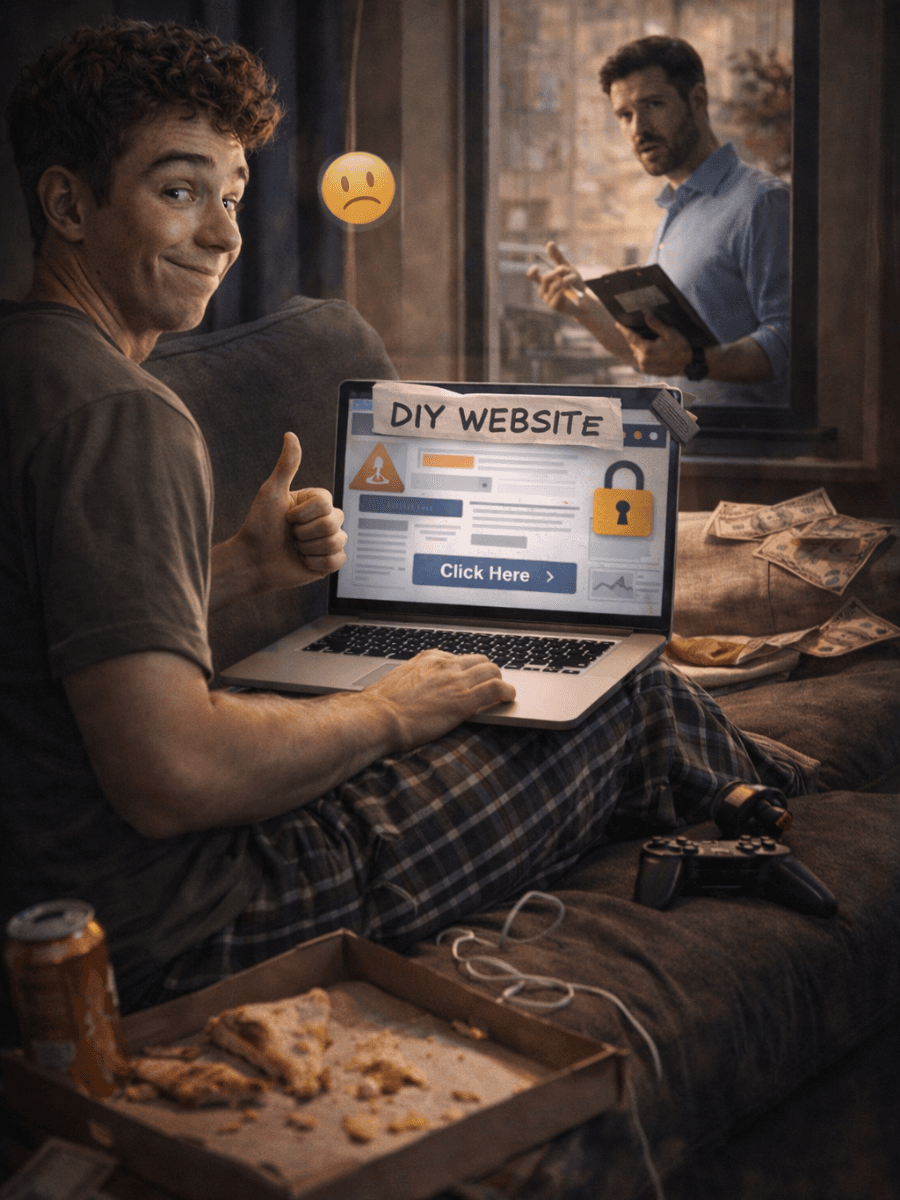
The honest answer that most agencies will not give you: if your website was built more than five years ago on an outdated platform, no amount of tweaking will make it perform in 2026. You can optimise the title tags and claim your Google Business Profile — and you should — but the underlying architecture is the ceiling. At some point, the smartest investment is a site built for how Google works today, not how it worked in 2019. For a deeper look at that decision, our upcoming piece "My Nephew Built My Website" — When DIY Costs More Than Hiring a Pro breaks down the real cost comparison.
The Engine8 Approach
Every site Engine8 builds is engineered for search visibility from the first line of code — clean URL structures, automatic sitemaps, server-side rendering that Google can crawl without breaking a sweat, and page speeds that pass Core Web Vitals without compromise. We do not bolt SEO on at the end. We build it into the architecture, because a site that Google cannot find is a site that does not exist.
If your website is invisible on Google and you are not sure whether the problem is fixable or fundamental, start a conversation with us. We will pull up your site, run the diagnostics, and tell you exactly what is holding you back — and whether a targeted fix or a rebuild is the smarter investment. No pitch decks. No filler. Just engineering.
Your move
Want leads from content like this?
Get a custom web engine with built-in SEO, analytics, and conversion systems.
Explore related keywords
Your move
Turn this strategy into a production-ready growth engine.
We design, build, and ship custom systems that combine SEO, conversion architecture, and operations automation into one platform.