What Happens When a Customer Leaves Your Site in 3 Seconds
When 70 out of 100 visitors leave your site in three seconds, that's not a traffic problem — it's a revenue leak with a dollar amount.
 Is My Website Holding Me Back?No. 06
What Happens When a Customer Leaves Your Site in 3 Seconds
May 2026
The 3-Second Window You Didn't Know About
A potential customer just typed exactly what you sell into Google. Your site showed up. They tapped the link. And three seconds later — before they read a single word, before they saw your phone number, before they had any idea what makes you different — they hit the back button and clicked on your competitor instead.
That is not a hypothetical. It is happening to your website bounce rate small business owners rarely track but always pay for. Google's own research found that 53% of mobile visits are abandoned if a page takes longer than three seconds to load. Pingdom's analysis of e-commerce sites showed bounce rates soar from 9% at two seconds to 38% at five seconds. Three seconds is not an arbitrary number — it is the cliff edge where you lose the room.
If you have been reading 7 Signs Your Website Is Costing You Customers, you already know a high bounce rate is one of the clearest red flags that your site is quietly bleeding money. This article breaks down exactly what happens during those three seconds, what each lost visitor actually costs, and what you can do about it — starting today.
What a Bounce Actually Costs You
Bounce rate is the percentage of visitors who land on your site and leave without clicking anything else. No second page. No contact form. No phone call. They arrived, they saw something they did not like — or did not see something fast enough — and they disappeared.
Here is where the math gets uncomfortable. Say you run a service business — plumbing, landscaping, legal work, whatever — and your average customer is worth $2,000 over a year. Your site gets 500 visitors a month. If your bounce rate is 70%, that means 350 people left without engaging. Even if only 5% of those would have converted into paying customers, that is 17 lost customers per month — $34,000 in annual revenue walking out the door.
Now layer on advertising. If you are running Google Ads or social media campaigns to drive traffic, every bounce is money you already spent on a visitor who gave you nothing back. A $3 cost-per-click on 350 bounced visitors is $1,050 a month in wasted ad spend — $12,600 a year — funnelling people to a site that pushes them away the moment they arrive.
Most business owners look at their traffic numbers and think "we need more visitors." They do not need more visitors. They need the visitors they already have to stop customers leaving my website before seeing what the business actually offers. The traffic is already there. The problem is the site.
Why People Leave Before They Even Read Anything
People do not leave your site because they decided you are a bad business. They leave because something failed in the first three seconds — before they formed any opinion about you at all. Here are the five most common reasons why visitors leave my site quickly:
The page loads too slowly
This is the number one killer. If your site takes more than three seconds to render usable content, the majority of visitors will not wait. Google's mobile speed study found that pages loading in five seconds see 2x lower ad revenue and 70% shorter sessions than pages loading in under two seconds. Every extra second of load time compounds the damage. Uncompressed images, bloated plugins, cheap hosting, and unoptimised code are the usual culprits.
The layout is confusing
A visitor who lands on your homepage needs to answer three questions in under five seconds: what does this business do, is it for me, and what do I do next. If your homepage is a wall of text, a slideshow of stock photos, or a cluttered mess with six competing calls to action, the visitor cannot answer those questions — so they leave.
It does not work on their phone
Over 60% of web traffic is mobile. If your site was designed on a 27-inch monitor and never tested on a phone, more than half your visitors see a broken experience — tiny text, overlapping buttons, navigation that requires three taps to open. We covered this in detail in Why Your Website Looks Great to You But Terrible on Your Customer's Phone. A broken mobile site is one of the fastest ways to drive your bounce rate through the roof.
No trust signals
A visitor who has never heard of your business is making a snap judgement about whether you are legitimate. No reviews, no portfolio, no professional photography, an expired SSL certificate, a design that looks like it was built in 2012 — any of these tells the visitor "this business might not be real" or "this business does not care enough to invest in itself." They bounce.
The call to action is buried or missing
Even if everything else works, a visitor who cannot figure out how to contact you or take the next step will leave. If your phone number is hidden in the footer, your contact form requires five clicks to reach, or there is no clear "get a quote" or "call us" button visible above the fold — you lose them. The easier you make the next step, the more people take it.
The Google Penalty Nobody Warns You About
Bounce rate does not just cost you the visitor who left. It costs you future visitors you will never see.
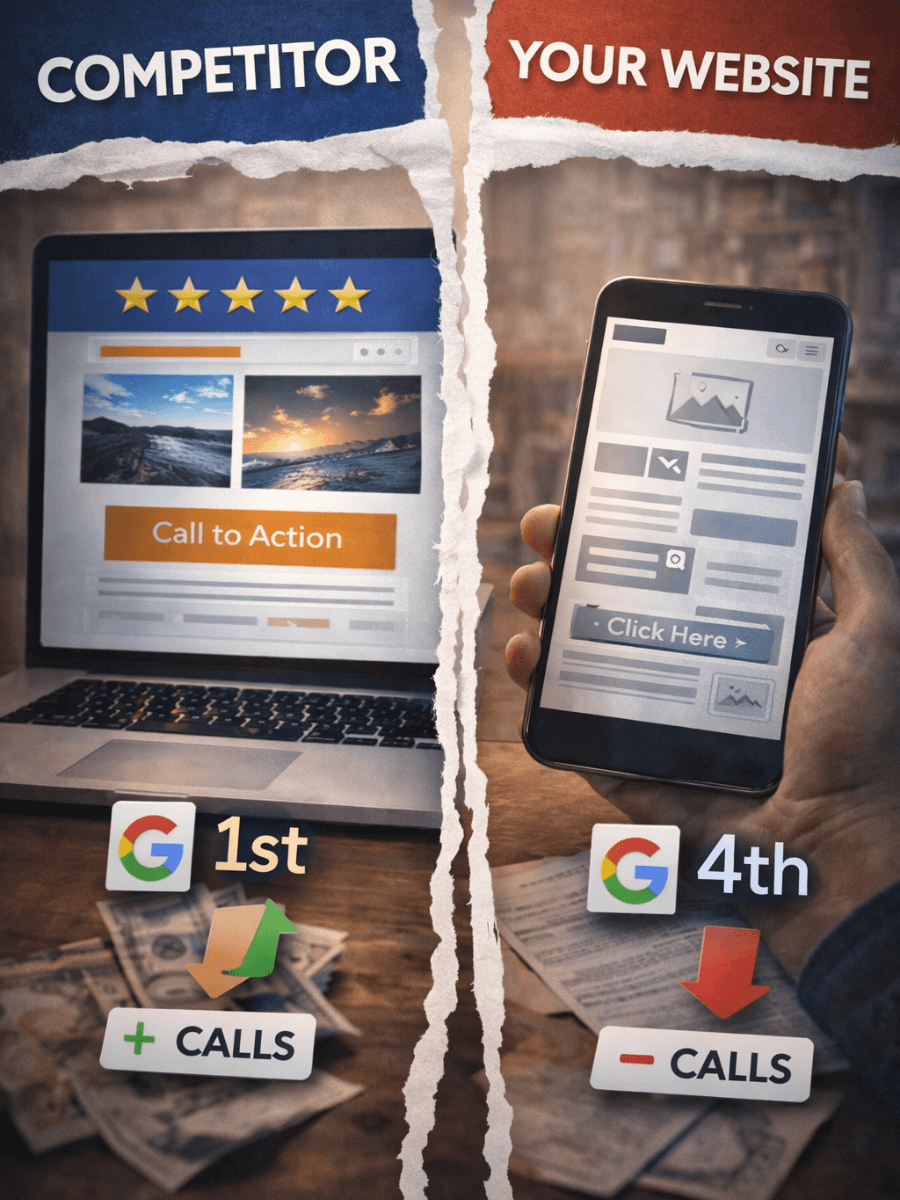
When someone searches on Google, clicks your result, and immediately bounces back to the search results, Google records that behaviour. It is called a short click or pogo-sticking — the user clicked your listing, found it unhelpful, and returned to try a different result. When this happens consistently, Google interprets it as a signal that your page did not satisfy the searcher's intent.
Over time, pages with high bounce-back rates get pushed lower in search results. Pages from your competitors — the ones visitors stick to — get pushed higher. It creates a downward spiral: fewer visitors find you, the visitors who do find you still bounce because the underlying problem is unfixed, and Google continues to demote you. Meanwhile, your competitor's site climbs.
This is compounded by Google's Core Web Vitals, which directly measure user experience signals like page load speed, visual stability, and interactivity. Sites that fail these metrics get flagged, and Google has confirmed that Core Web Vitals are a ranking factor. A slow, bouncy site does not just disappoint visitors — it actively undermines your position in search results.
The worst part is that this damage is invisible. You will not get a notification from Google saying "your site is being demoted because visitors keep leaving." You just notice that leads dry up, phone calls slow down, and your competitors seem to be getting busier. By the time you connect the dots, months of ranking damage have accumulated.
How to Find Out If You Have a Bounce Problem
Most business owners have never looked at their bounce rate. If you have Google Analytics installed — and if you do not, that is a problem in itself — here is where to find it.
In Google Analytics 4, navigate to Reports → Engagement → Pages and screens. Look for the "Bounce rate" column. If you do not see it, you can add it using the customise report option. GA4 defines a bounce as a session that was not "engaged" — meaning the user stayed less than 10 seconds, viewed only one page, and did not trigger any conversion events.
As a general benchmark, bounce rates between 26% and 40% are considered excellent. Between 41% and 55% is roughly average. Anything above 70% is a problem that is actively costing you customers. For context, Pingdom's research across e-commerce sites showed an average bounce rate of 9% for pages loading in under two seconds — but that number soared to 38% once load time crossed three seconds and hit 73% in the worst cases.
But numbers on a screen only tell you that there is a problem. They do not tell you why visitors are leaving. That requires a different kind of analysis — one that looks at what your visitors actually experience when they land on your site.
Engine8's free site evaluation does exactly this. Enter your URL and get a real performance breakdown in under 60 seconds — page speed, mobile experience, layout issues, and conversion friction — all scored against the benchmarks that separate sites that convert from sites that bleed. No sign-up, no credit card, no sales pitch. It is the same diagnostic framework we use before scoping any project, and it will tell you whether your bounce rate is a speed problem, a design problem, or a content problem — so you know what to fix first.
Quick Wins That Keep People on Your Site
You do not need a full redesign to start reducing bounces. Some of the highest-impact fixes are straightforward — and they compound. Here are the ones that move the needle fastest, ordered by impact:
Speed up your page load
Compress your images. Remove plugins and scripts you are not using. Upgrade from bargain-basement hosting to a CDN-backed provider. These changes alone can shave seconds off your load time. Remember: the difference between a two-second load and a five-second load is the difference between a 9% bounce rate and a 38% bounce rate.
Write a clear headline
The very first line of text a visitor sees should answer the question: "What does this business do and is it for me?" Not a clever tagline. Not a mission statement. A clear, specific statement of what you offer and who you offer it to. "Commercial plumbing for restaurants and retail in Denver" beats "Your trusted partner in plumbing excellence" every time.
Put a call to action above the fold
The visitor should not have to scroll to find out how to contact you or take the next step. A prominent button — "Get a free quote," "Call us now," "Book an appointment" — visible without scrolling on both desktop and mobile. Make the next step obvious and frictionless.
Fix your mobile experience
If your site is not responsive — meaning it does not automatically adapt to phone screens — you are losing the majority of your visitors. Readable text, tappable buttons, accessible navigation. This is not optional. Engine8 builds every site mobile-first for exactly this reason.
Add trust signals immediately
Reviews, testimonials, client logos, years in business, licences, certifications — whatever proof you have that you are real and competent, put it where visitors see it within the first scroll. Social proof is one of the fastest ways to keep a hesitant visitor on your page long enough to become interested.
These are not silver bullets. If the underlying architecture of your site is broken — outdated platform, spaghetti code, no responsive framework — quick fixes will only get you so far. But for many businesses, these five changes alone can cut bounce rates significantly and start recovering the revenue that has been leaking for months or years.
The Engine8 Approach
Every site Engine8 builds is engineered to pass the three-second test. Fast load times on real connections. Clear messaging above the fold. Calls to action that a visitor can find without thinking. Mobile-first layouts tested on real devices. No template compromises, no page-builder bloat — custom code tuned to convert from the first visit.
We build sites this way because the math is straightforward: if your site loads in under two seconds and delivers a clear message instantly, your bounce rate drops, your ad spend stops leaking, and Google starts sending you more traffic instead of less. That is not a theory — it is what happens when performance and design are treated as engineering problems rather than aesthetic ones.
If you are not sure whether your site is passing or failing the three-second test, run the free evaluation — it takes less time than the visitors you are losing. And if the numbers confirm what this article describes, start a conversation with us. We will break down exactly where the leaks are and what it takes to fix them — no pitch decks, no filler, just engineering.
Your move
Want leads from content like this?
Get a custom web engine with built-in SEO, analytics, and conversion systems.
Explore related keywords
Your move
Turn this strategy into a production-ready growth engine.
We design, build, and ship custom systems that combine SEO, conversion architecture, and operations automation into one platform.