Custom Website vs Shopify: The Real Cost Over 3 Years
Shopify says $29 a month. After 3 years of transaction fees, apps, and workarounds, the real number looks very different.
 Custom vs TemplatesNo. 10
Custom Website vs Shopify: The Real Cost Over 3 Years
Jul 2026
The $29/Month Lie
Every business owner shopping for a website has seen the number: $29 per month. Shopify plasters it across every ad, every landing page, every comparison chart. Twenty-nine dollars a month for a full online store. That is less than your coffee budget. That is practically free.
Except it is not $29 a month. Not even close. Once you add transaction fees, a theme that does not look like everyone else's, the apps you need to actually run a store, and the inevitable developer hours when something breaks — the real number is dramatically higher. And that gap between what Shopify advertises and what Shopify actually costs is the entire reason this article exists.
This is an honest, numbers-driven comparison of the custom website vs Shopify cost over a three-year period. Not a hit piece on Shopify — the platform does some things very well. Not a sales pitch disguised as analysis — you will see the numbers and draw your own conclusions. The goal is simple: show you what both paths actually cost, so you can make the decision that makes sense for your business.
What Shopify Actually Costs Over 3 Years
Let us build the real number, line by line. We will use Shopify's Basic plan — the one most small businesses start with — paid annually at $29 per month.
The Base Subscription
Shopify Basic (annual billing): $29/m = $1,044 over 3 years. That is the number they want you to remember. Everything below is what they hope you will not calculate until you are already locked in.
Transaction Fees
If you use Shopify Payments (their built-in processor), you pay 2.9% + 30 cents per online transaction. If you use any other payment gateway — PayPal, Stripe, Square — Shopify charges an additional 2% transaction fee on top of whatever your processor charges. That means you could be paying close to 5% per transaction just to accept money on your own website.
For a store doing $10,000/month in sales using Shopify Payments: that is roughly $320/month in processing fees, or $11,520 over 3 years. Using a third-party gateway, add another $200/month — $7,200 more over 3 years.
Premium Theme
Shopify's free themes are functional but generic. Most serious businesses buy a premium theme to stand out. Cost: $250 to $400, one-time. But "one-time" is generous — most stores redesign or switch themes at least once in three years. Call it $350 to $700 over 3 years.
Essential Apps
This is where the Shopify total cost of ownership goes from uncomfortable to alarming. Shopify's app ecosystem is massive because the core platform does not do everything a real store needs. Here is what a typical small business installs:
Email marketing (Klaviyo, Mailchimp): $20–$50/month
Product reviews (Judge.me, Loox): $15–$30/month
SEO tools (SEO Manager, Smart SEO): $10–$20/month
Abandoned cart recovery (beyond Shopify's basic version): $10–$30/month
Upsell/cross-sell (ReConvert, Bold): $15–$30/month
Advanced shipping (ShipStation, ShippingEasy): $10–$25/month
Backup/security (Rewind): $5–$10/month
Conservative estimate: $85–$195/month in apps. Let us call it $120/month. Over three years: $4,320. And that only grows as your store does — bigger email lists mean bigger Klaviyo bills, more products mean more app fees.
Developer Customisation
At some point, you will need a Shopify developer to fix something the theme cannot do, integrate an app that conflicts with another app, or build a feature that no app provides. The average Shopify developer charges $75–$150/hour. Budget at least $1,500–$3,000 over 3 years for miscellaneous fixes and tweaks.
The Shopify 3-Year Total
Adding it up for a store doing $10,000/month in revenue:
Base subscription: $1,044
Transaction fees (Shopify Payments): $11,520
Premium theme(s): $500
Essential apps: $4,320
Developer customisation: $2,000
Total: approximately $19,384 over 3 years. That is $538/month — not $29. And if you are using a third-party payment processor, add another $7,200 and push that total past $26,000.
Think of it like this: Shopify's $29/month is the cover charge. The drinks, the food, the coat check, the parking — that is where the real bill lives. You got into the club, but the tab at the end of the night is eighteen times what you expected.
What a Custom Website Actually Costs Over 3 Years
Now the other side. A custom website for small business has a completely different cost structure: higher upfront, lower ongoing, zero platform tax.
Upfront Development
A professionally built custom website typically costs between $5,000 and $15,000 depending on scope, complexity, and the developer. A standard business site with five to ten pages, contact forms, and modern design sits at the lower end. An e-commerce build with custom product configurators, booking systems, or API integrations pushes toward the higher end. Let us use $8,000 as a realistic midpoint (Engine8 projects start in this range — see our pricing for specifics).
Hosting and Infrastructure
Modern custom sites built on frameworks like Next.js deploy to platforms like Vercel, where the Pro plan runs $20/month. Add a domain name at $12/year. No bandwidth surprises, no server management, no forced upgrades. Total hosting over three years: $756.
Maintenance and Updates
A good developer offers ongoing maintenance — content updates, security patches, performance monitoring. Budget $100–$200/month for a light retainer, or pay as needed. Over three years with a retainer: $3,600–$7,200. Without a retainer (pay-as-you-go): $1,500–$3,000.
Payment Processing
With a custom site, you integrate Stripe or your preferred processor directly. Stripe charges 2.9% + 30 cents — the same as Shopify Payments — but with zero additional platform fee. The 2% third-party surcharge that Shopify adds? It does not exist. For a store doing $10,000/month, that saves $200/month or $7,200 over 3 years compared to a Shopify store using a non-Shopify gateway.
The Custom 3-Year Total
Upfront development: $8,000
Hosting (Vercel Pro + domain): $756
Maintenance retainer: $5,400 (midpoint)
Transaction fees (Stripe only — same rate, no platform surcharge): $11,520
Total: approximately $25,676 over 3 years — or $713/month. Higher than Shopify's $538/month if you are using Shopify Payments. But there is a catch: that $8,000 upfront cost is a one-time investment. If you extend the comparison to year four and five, the custom site drops below Shopify because there is no subscription creep, no app inflation, and you own the asset outright.
The Side-by-Side Comparison
Here is where the picture gets interesting. The numbers shift depending on your revenue, payment processor, and how many apps you need.
At $10,000/Month Revenue (Shopify Payments)
Year 1 — Shopify: ~$6,460 | Custom: ~$14,360 (heavy upfront)
Year 2 — Shopify: ~$6,460 | Custom: ~$5,660
Year 3 — Shopify: ~$6,460 | Custom: ~$5,660
3-Year total — Shopify: ~$19,384 | Custom: ~$25,676
5-Year total — Shopify: ~$32,300 | Custom: ~$31,996
The breakeven point for a custom site is somewhere around year four to five. After that, custom is cheaper every single year — and the gap widens the longer you operate.
Beyond the Dollars
Cost is only half the equation. Here are the non-monetary factors that do not show up in any spreadsheet:
Ownership: With Shopify, you are renting. Cancel your plan and your store disappears — design, content, all of it. A custom site is yours. You own the code, the design, and the domain. You can move it, modify it, or sell it. We go deep on this in What You Actually Own When Your Website Is Built From Scratch.
Flexibility: Shopify gives you choices within its system. A custom site gives you choices, period. Want a unique checkout flow? A product configurator? An integration with your warehouse software? Custom has no ceiling.
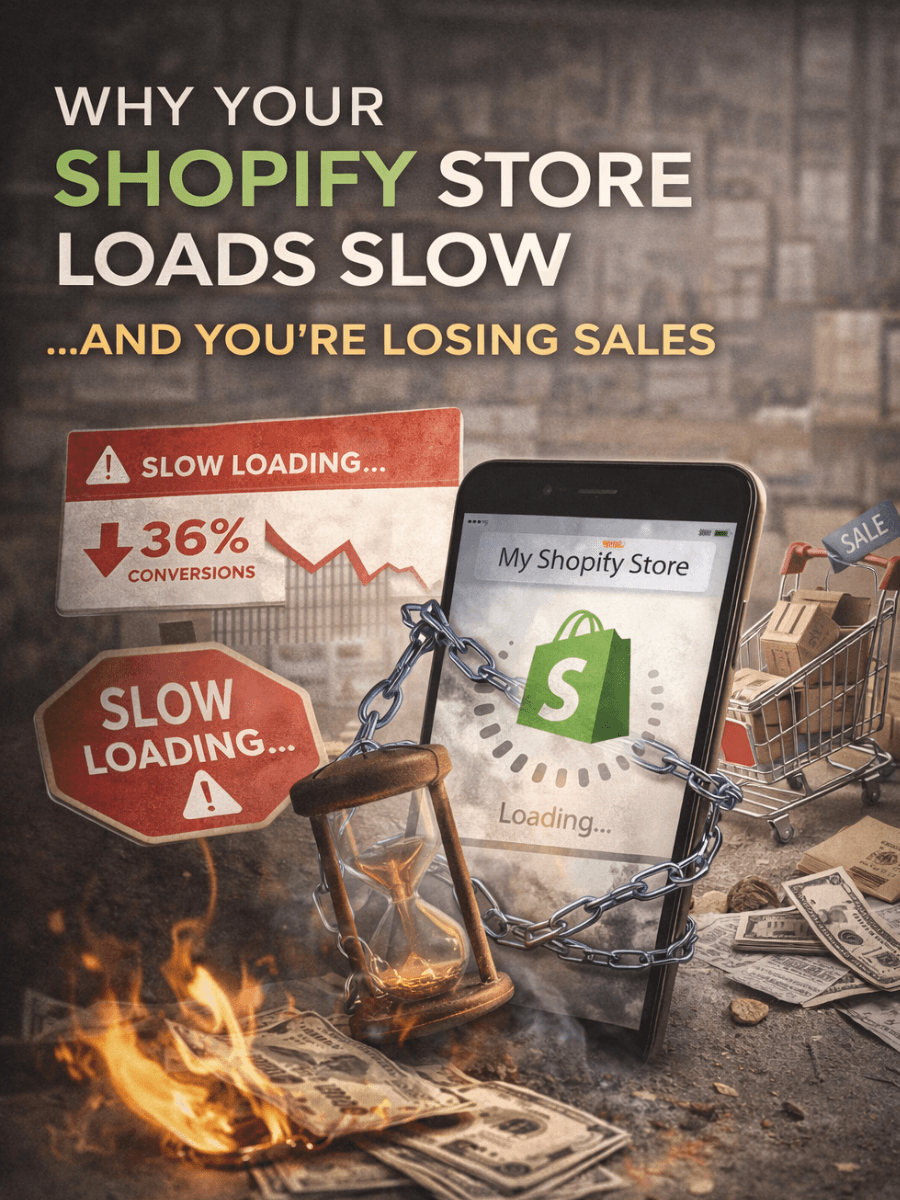
Performance: Shopify loads between 70 and 120 apps via JavaScript on many stores, tanking page speed. A custom site loads exactly what it needs — nothing more. Our upcoming article Why Your Shopify Store Loads Slow and What It's Doing to Your Sales digs into the performance gap and what it costs you in conversions.
Scalability: Shopify scales well for standard e-commerce. But the moment your business model diverges from "products in a catalogue," the platform starts fighting you instead of helping you.
Think of it like this: Shopify is a rental apartment. It is move-in ready, the landlord handles repairs, and you can hang pictures on the walls. But you cannot knock out a wall, you cannot add a deck, and if you stop paying rent, you are out — furniture and all. A custom website is a house you own. It costs more upfront, but every dollar you put into it builds equity that stays with you.
When Shopify Wins
Let us be honest — Shopify is not a bad product. For certain businesses, it is genuinely the right choice. Here is when:
You are launching fast with a limited budget. If you have less than $5,000 to spend and need to be selling next week, Shopify gets you there. Speed to market matters, and Shopify's infrastructure is ready on day one.
You sell standard products with standard checkout. T-shirts, candles, accessories — if your products fit neatly into a catalogue-and-cart model, Shopify handles it well.
You do not have access to a developer you trust. Shopify's admin panel is designed for non-technical users. If you have no developer and no budget for one, managing your own store on Shopify is realistic.
You are testing a new business idea. Before investing $8,000+ in a custom build, it can be smart to validate demand on a platform. If the idea works, you upgrade. If it does not, you have not sunk a five-figure budget.
For more on the budget question — when spending less truly makes sense and when it backfires — see When a $500 Website Is Fine (And When It's Costing You Money).
When Custom Wins
Custom pulls ahead when any of the following are true:
Your business model is not standard e-commerce. Services, bookings, custom quoting, multi-step configurators, membership models — anything that does not fit Shopify's catalogue-and-cart system. Forcing a non-standard model into Shopify means stacking apps, hiring developers to write workarounds, and constantly fighting the platform's assumptions.
You need performance to compete. Page speed directly affects conversion rates and search rankings. A custom site loads in under a second. A Shopify store loaded with apps? Often three to five seconds. That gap costs you real money every day.
You plan to operate for more than three years. The longer your timeline, the more custom saves — because you are not paying monthly rent on apps, themes, and platform fees that compound year over year.
Brand differentiation matters. If every competitor in your space uses the same Shopify themes with the same layouts and the same checkout flow, you look exactly like them. A custom site is yours alone.
You want to own your asset. A custom website is intellectual property. It can be valued, sold, or migrated. A Shopify store is a tenancy agreement — you hold the lease, not the deed.
Engine8 builds exactly this kind of site. When a business has outgrown the template phase and needs a website that is engineered around their specific model — not squeezed into a platform's assumptions — that is where we work. Run your current site through our free site evaluation to see how it stacks up on speed, mobile experience, and SEO fundamentals. It takes under 60 seconds, no sign-up required, and it will show you exactly where the gaps are.
Think of it like this: nobody questions why a restaurant owner eventually moves from a food truck to a permanent location. The truck got you started. The truck proved the concept. But at some point, the permanent location gives you the kitchen, the seating, and the capacity that the truck physically cannot. Your website works the same way.
Fun Facts
Shopify powers over 4.8 million stores worldwide — but the average Shopify store installs 6 to 8 paid apps just to match the functionality that comes standard on a custom-built site.
The premium theme market on Shopify generates over $100 million per year. That is $100 million spent by merchants trying to make their template not look like a template.
Shopify's revenue per merchant has increased every single year since 2015 — not because stores are selling more, but because Shopify keeps adding new revenue streams (payments, capital, shipping, apps).
The average Shopify store's page weight is 4.5 MB. The average custom-built Next.js site? Under 500 KB — nine times lighter. Every extra megabyte adds roughly half a second of load time on mobile.
Shopify's own documentation recommends no more than 20 apps per store for performance reasons. The average store uses 25+.
The Full Platform Comparison
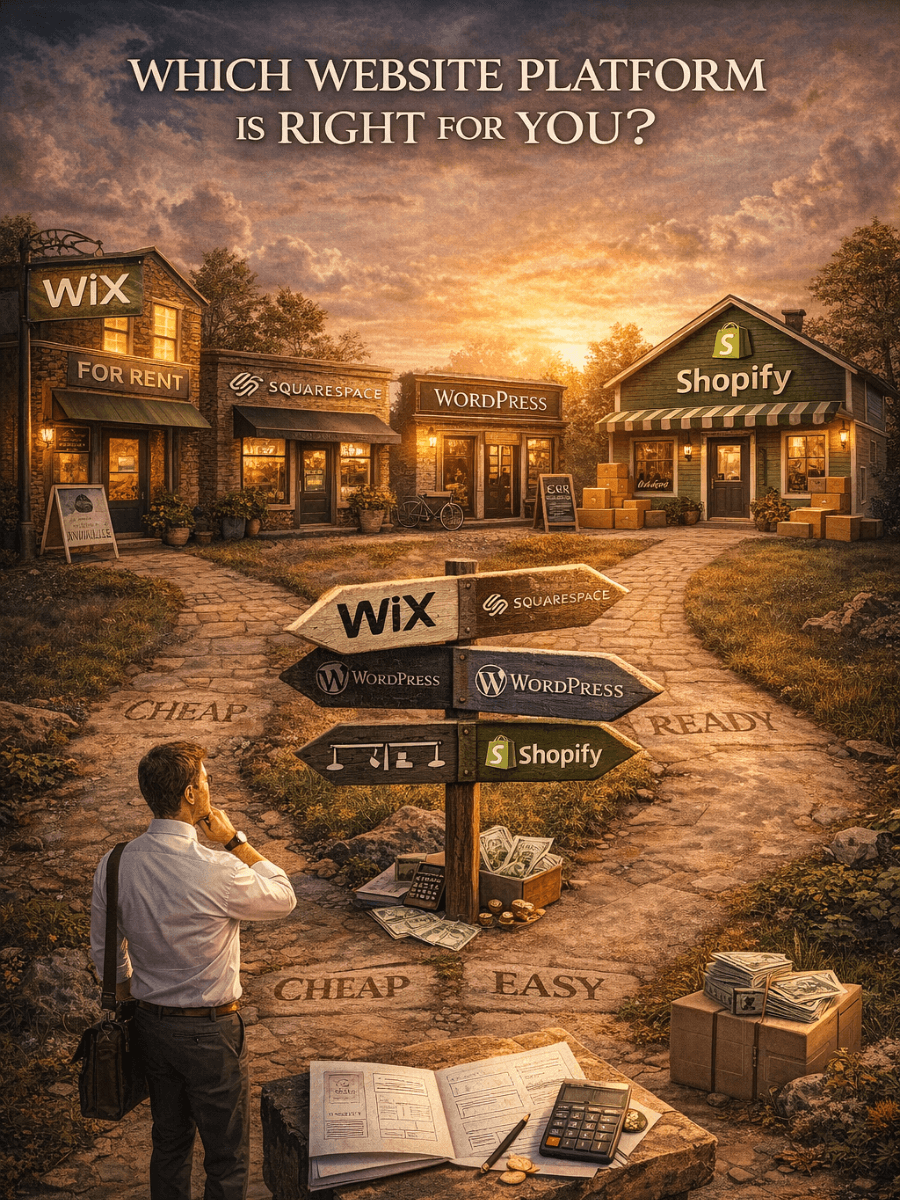
Shopify is not the only template platform, of course. Wix, Squarespace, WordPress, Shopify — An Honest Comparison for Business Owners walks through all four platforms side by side if you are still weighing your options. And The Hidden Monthly Fees of Template Platforms Nobody Warns You About breaks down the fee structures that every platform conveniently buries in their pricing pages.
For businesses selling unique or custom products, the platform trap is even more pronounced. Selling Unique Products Online Without Getting Trapped by a Platform covers the specific challenges of selling non-standard goods on template platforms — and why those businesses are often the first to outgrow them.
If you came to this article from the Is My Website Holding Me Back? cluster, you already know the signs. And if the DIY path led you here, "My Nephew Built My Website" — When DIY Costs More Than Hiring a Pro covers the personal-build version of this same cost trap.
The Engine8 Approach
Engine8 builds custom websites and web engines for businesses that have outgrown the template phase. No app subscriptions. No platform fees. No monthly rent on someone else's infrastructure. Every site is engineered from scratch — built to load fast, rank well, convert visitors into customers, and belong entirely to the business that paid for it.
If the numbers in this article made you look twice at your current platform costs, or if you are starting to feel the ceiling of what Shopify or Wix or Squarespace can do for your business — start a conversation. We will pull up exactly what your current site is costing you, show you what a custom build looks like for your specific model, and give you the real numbers on both paths. No pitch decks. No filler. Just engineering.
Your move
Want leads from content like this?
Get a custom web engine with built-in SEO, analytics, and conversion systems.
Explore related keywords
Your move
Turn this strategy into a production-ready growth engine.
We design, build, and ship custom systems that combine SEO, conversion architecture, and operations automation into one platform.